Assessments and Cost:
Assessment fees vary depending on location and local programme structure.
Because we work across South Africa, Africa, United Kingdom and Ireland, costs may differ between countries to reflect local practice requirements and operational considerations.
All assessments include:
A comprehensive binocular vision and visual perception assessment
Time for observation, analysis, and interpretation
A clear explanation of findings
Individualised recommendations and next steps
Specific pricing details are provided at the time of enquiry or booking.
Please contact us to discuss current fees in your location.
We Asess Beyond eyesight: understanding how the two eyes work together
Most standard eye tests assess monocular vision — how clearly each eye sees on its own. Seeing 20/20 with one eye at a time does not mean vision is working efficiently
Our assessment is different.
We do not test eyesight.
We assess binocular vision and visual perception — how the two eyes work together and how that information is processed and integrated by the brain.
This distinction is critical for learning, attention, and coordination.
Most people who come to us:
Passed standard eye tests
Has 20/20 distant vision in each eye
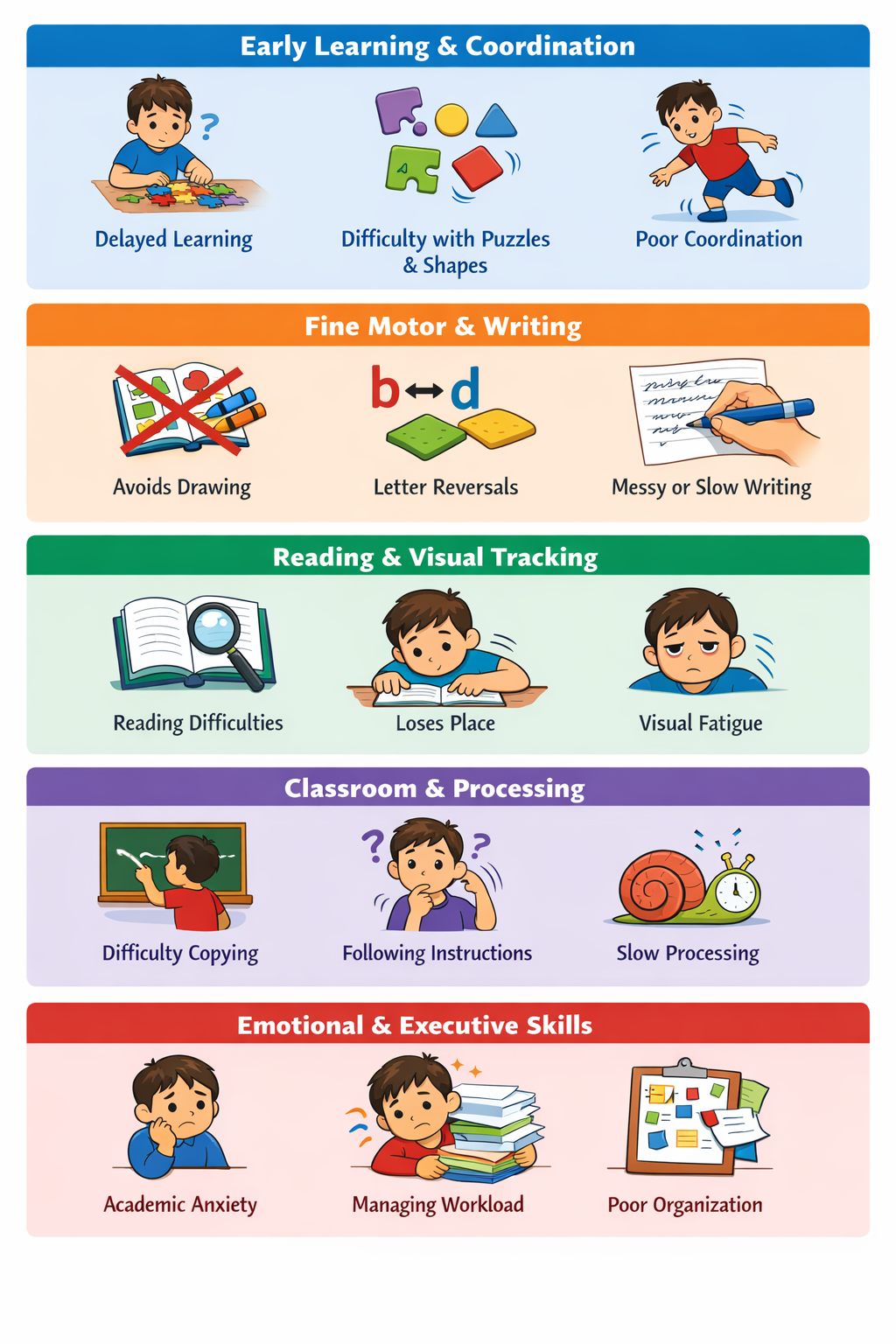
Ongoing struggles with learning, focus, or visual fatigue
This is because monocular clarity does not reflect visual efficiency.
Our assessment focuses on:
How well the eyes work together
Stability and coordination of binocular vision
How visual information is organised and processed
How vision integrates with movement, posture, and attention
These skills form the foundation for reading, writing, and sustained concentration.
Why Binocular Vision Matters
Learning happens with both eyes working together.
If binocular vision is unstable or inefficient:
The brain works harder to maintain focus
Visual tasks fatigue quickly
Reading and copying require extra effort
Attention and confidence are affected
These challenges are often invisible in standard vision screenings.
What We Often See
What we observe during assessment is often eye-opening for families.
Not because eyesight is poor — but because binocular vision has never been assessed in this way before.
When binocular vision and visual perception are evaluated through a developmental lens, long-standing struggles finally have a clear explanation.
A Foundation for Targeted Change
Our assessment provides:
A clear understanding of binocular vision strengths and challenges
Insight into how visual perception is impacting learning and daily tasks
A structured roadmap for meaningful, developmentally appropriate intervention
Built on Over 30 Years of Clinical Insight
Developed by Elsa du Plessis over more than three decades, the Elsa Protocol reflects a deep understanding of binocular vision development and visual perception.
This depth allows us to identify inefficiencies that standard tests do not measure.
Because Vision Is Not Just About Seeing Clearly
It’s about how efficiently the brain can use what the eyes provide.